American Option Pricing Engine
GPU-accelerated Bermudan option pricing by Longstaff-Schwartz least-squares Monte Carlo, in CUDA and OpenMP.
Started as a reimplementation of Cvetanoska & Stojanovski, "Using High Performance Computing and Monte Carlo Simulation for Pricing American Options" (arXiv 1205.0106). The paper prices with a perfect-foresight estimator: its algorithm, in its own words, "assume[s] that all future values of the underlying stock price are known" and so "gives the upper bound value of the American option." That upper bound is badly divergent — 56% high at 21 exercise dates, growing without bound — yet the paper presents it as an American-option price. This engine replaces it with Longstaff-Schwartz, the method the paper cites ([12]) but doesn't use, validates the result against two independent references, and runs it 53× faster than a serial CPU baseline.
| Exact price (Black-Scholes, non-dividend call) | 10.450584 |
| This engine (QMC, 4M paths) | 10.450566 — error −1.7e-5 |
| The paper's upper-bound method | 16.34 — error +5.89 |
| Speedup | 53.4× serial · 10.0× 28-thread OpenMP |
| Tests | 17 checks, 2 suites, all passing |
The headline result

An American call on a non-dividend-paying stock is worth exactly its European counterpart — early exercise is never optimal. That makes Black-Scholes an exact yardstick, and any gap is bias, not noise.
The paper values each path with max(intrinsic, discounted continuation) using
that path's own realised future — which, as it acknowledges, gives an upper
bound rather than a price. Every path exercises with hindsight, so the estimate is
biased high and gets worse the more exercise dates you give it. Longstaff-Schwartz
fixes this by estimating continuation from a cross-path regression instead of the
realised future.
How it works
flowchart LR
    A["Simulate N paths<br/>GBM, m+1 timesteps"] --> B["Node m<br/>European value of<br/>remaining dt"]
    B --> C{"For i = m-1 … 1"}
    C --> D["Discount every<br/>cashflow one step"]
    D --> E["Regress cashflow on<br/>1, x, x² over<br/>in-the-money paths"]
    E --> F["Exercise where<br/>intrinsic > fitted<br/>continuation"]
    F --> C
    C -->|done| G["Mean × discount<br/>= price ± stderr"]
Two details make it correct rather than merely plausible:
- The regression supplies the exercise decision only. Valuation always uses the realised cashflow, never the fitted value. Substituting the fit back in reintroduces bias.
- Only in-the-money paths enter the regression. Out-of-the-money paths carry no decision, and including them degrades the fit exactly where the exercise boundary lives.
The estimator is low-biased: a fitted policy is suboptimal, and a suboptimal exercise policy under-values. That is the safe direction.
Time grid
With dt = T/(m+1), path value S[i] sits at i·dt. The last grid point is at
T − dt, not T: the m exercise opportunities are at dt, 2dt, …, m·dt, and the
option still has dt of life left after the final one. Node m therefore needs no
regression — holding is worth the European value over the remaining step, which is an
exact conditional expectation.
Validation
A call cannot distinguish "LSM works" from "LSM never exercises", because never exercising is the right answer there. So the suite checks both directions:
flowchart TD
    subgraph exact ["Exact references"]
        BS["Black-Scholes<br/>closed form"]
        TREE["CRR binomial tree<br/>same m exercise dates"]
    end
    subgraph mc ["Monte Carlo backends"]
        CALL["Call<br/>never exercises early"]
        PUT["Put<br/>exercise boundary binds"]
    end
    BS -->|"must match exactly"| CALL
    TREE -->|"must match within 0.14%"| PUT
    CALL --> V["17 checks<br/>all passing"]
    PUT --> V
    XB["Cross-backend checks<br/>GPU vs CPU · 1 vs 28 threads"] --> V
The tree is restricted to the same m exercise dates the Monte Carlo grid uses,
so both price the identical Bermudan. Comparing against a fully American tree would
be apples to oranges — continuous exercise is worth strictly more than m discrete
dates.
| Check | What it catches | Result |
|---|---|---|
| American call == European | Any bias; does not shrink with N | err < 0.017 |
| American put vs CRR tree | A wrong exercise boundary | within 0.14% |
| Early-exercise premium > 0 | An exercise rule that never fires | +1.2192 |
| Sobol vs van der Corput | Bit-reversed direction numbers | exact |
| OpenMP 1 thread vs 28 | A wrong reduction in the regression | 2.8e-13 |
| GPU QMC vs host QMC | Device Sobol/bridge/LSM drift | < 1e-6 |
| fp32 vs fp64 paths | Precision loss that actually matters | 8e-6 |
Performance
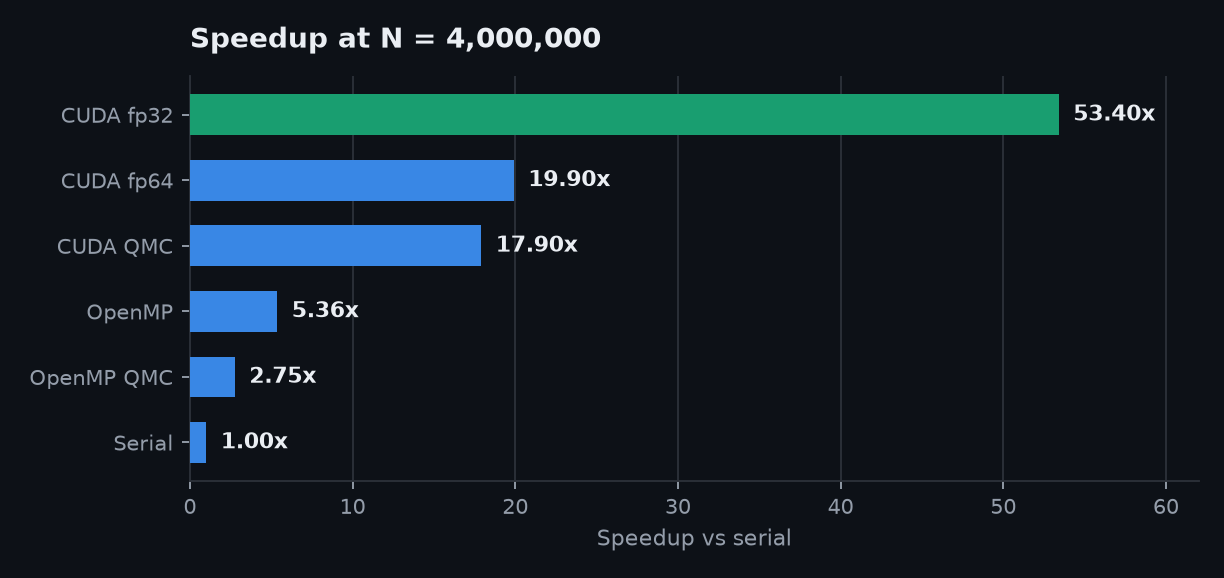

Intel i7-14700HX (20C/28T) · RTX 5060 Laptop · CUDA 12.4 · S₀=X=100, T=1, r=5%, σ=20%, m=20
| Backend | Price @ 4×10⁶ | Error | Time | vs serial |
|---|---|---|---|---|
| Serial (LCG) | 10.452417 | +0.001834 |
3199.8 ms | 1.00× |
| OpenMP, 28 threads | 10.452417 | +0.001834 |
596.7 ms | 5.36× |
| OpenMP QMC | 10.450566 | −0.000017 |
1163.0 ms | 2.75× |
| CUDA, fp64 paths | 10.452417 | +0.001834 |
160.6 ms | 19.9× |
| CUDA, fp32 paths | 10.452409 | +0.001825 |
59.9 ms | 53.4× |
| CUDA QMC | 10.450566 | −0.000017 |
178.9 ms | 17.9× |
Convergence

QMC reaches three-decimal accuracy at 100,000 paths where the pseudo-random backends need 1,000,000. The LCG curve ticking up between 10⁶ and 4×10⁶ is not a bug — Monte Carlo error is a random walk around zero, not a monotone decline.
Profiling: two wrong guesses, then the real bottleneck
The first correct version ran only 19× serial, which is poor for an embarrassingly
parallel problem. Rather than guess, ./build/profile_gpu splits device time into
path generation and the LSM backward pass. It killed both obvious hypotheses:
| Hypothesis | Measured reality |
|---|---|
| The 19 host round trips for the regression solve dominate | Under 1 ms of a 56 ms pass |
| Uncoalesced reads dominate (paths were point-major, threads 168 B apart) | Time-major layout changed runtime < 2% |
| — | FP64 arithmetic in path generation: 63% |
Path generation is transcendental-heavy — one exp per step plus two logs in
Moro's tail branch — on a card that runs doubles at 1/64 the FP32 rate. Moving path
storage and generation to fp32, while keeping the regression accumulation in
double, gives 2.7× for a price change of 8e-6 against a Monte Carlo standard
error of 7.1e-3 — a thousandth of the noise it sits inside.
The time-major layout was kept regardless. It is the correct layout and costs nothing; it simply was not the bottleneck.
A bug the fp32 experiment surfaced
At four million paths the single-precision run returned inf.
__uint2float_rn(0xFFFFFFFF) rounds up to exactly 2³², so the float LCG can emit
exactly 1.0, and Moro then evaluates log(−log(0)). The same hole existed in the
double path all along — LCG state 0 gives u = 0 — merely rare enough never to
have fired. Both are now clamped inside Φ⁻¹ itself, where the function is genuinely
undefined, rather than at the four call sites. Two regression tests cover it.
Build
cmake -S . -B build -DCMAKE_BUILD_TYPE=Release
cmake --build build -j
ctest --test-dir build --output-on-failure
CUDA targets are skipped automatically if no toolkit is present; -DUSE_CUDA=OFF
skips them deliberately.
Host compiler: nvcc pins its own supported GCC (CUDA 12.4 tops out at GCC 13). If your default
g++is newer, configure with-DCMAKE_CXX_COMPILER=g++-13, or linkingrun_cuda_testsfails on an undefined__cxa_call_terminate. CMake warns when it detects the mismatch.
CUDA arch: defaults to
sm_80with PTX emitted alongside, so newer GPUs JIT. Override with-DCMAKE_CUDA_ARCHITECTURES=89(Ada),90(Hopper), etc.
Run
./build/american_serial                 # any of the five backends
./build/american_cuda   call fp32       # [call|put] [fp64|fp32]
./build/american_qmc_cuda put
./build/profile_gpu                     # setup / pathgen / LSM breakdown
./build/validate                        # CPU validation suite
Documentation
| Document | For |
|---|---|
docs/REPORT.md |
The full write-up — problem, method, correction, validation, profiling, limitations. Start here. |
docs/ARCHITECTURE.md |
Contributors: module map, design decisions and why, numerical gotchas |
docs/benchmark-results.html |
Interactive results dashboard, self-contained, open from disk |
docs/results/ |
Raw harness output behind every figure |
Charts regenerate with python3 docs/make_charts.py.
Layout
src/core/     hd_math.hpp     option math compiled for host AND device
              lsm.{hpp,cpp}   Longstaff-Schwartz regression + backward pass
              paths.*         path simulation (shared by serial and OpenMP)
              binomial.*      CRR tree — independent oracle for the tests
              sobol, halton, brownian_bridge, scramble, moro, black_scholes
              backward_induction.hpp   the paper's naive recursion, kept only
                                       so the bias comparison can be made
src/cuda/     path-generation kernels, lsm_gpu.cu (device backward pass),
              cuda_check.h (CUDA_TRY error macros)
src/openmp/   OpenMP backends, standard and QMC
src/benchmark/ benchmark drivers and the GPU profiler
tests/        validate.cpp (no GPU needed) · test_cuda.cpp (GoogleTest)
Known limitations
These are open, not hidden:
- Pseudo-random streams are not independent. Path seeds are
(path_id + 1) × 1234567on a 2³² LCG, so neighbouring paths walk correlated positions on the same lattice. A counter-based generator (cuRAND Philox) is the fix. - No error bar on the QMC result.
sd/√Nassumes independent draws and Sobol is deterministic; at 4×10⁶ the QMC backends report a standard error of0.0071while the actual error is0.000017. A real bound needs randomised QMC — average over several independent digital shifts and take the sd of the means. - LSM is low-biased, so a true confidence interval needs a paired upper bound (the Andersen-Broadie dual).
- Memory bounds the problem. The regression is cross-sectional, so the whole path
set must be resident:
N × (m+1)values, 336 MB at N=4×10⁶ in fp64. - The GPU is handicapped here. CUDA 12.4 has no native sm_120 target, so kernels arrive by PTX JIT from sm_80.
References
Glasserman, Monte Carlo Methods in Financial Engineering (Springer, 2004) · Longstaff & Schwartz, "Valuing American Options by Simulation: A Simple Least-Squares Approach", RFS 14(1), 2001 · Joe & Kuo, "Constructing Sobol sequences with better two-dimensional projections", SIAM J. Sci. Comput. 30, 2008 · Cvetanoska & Stojanovski, "Using High Performance Computing and Monte Carlo Simulation for Pricing American Options".